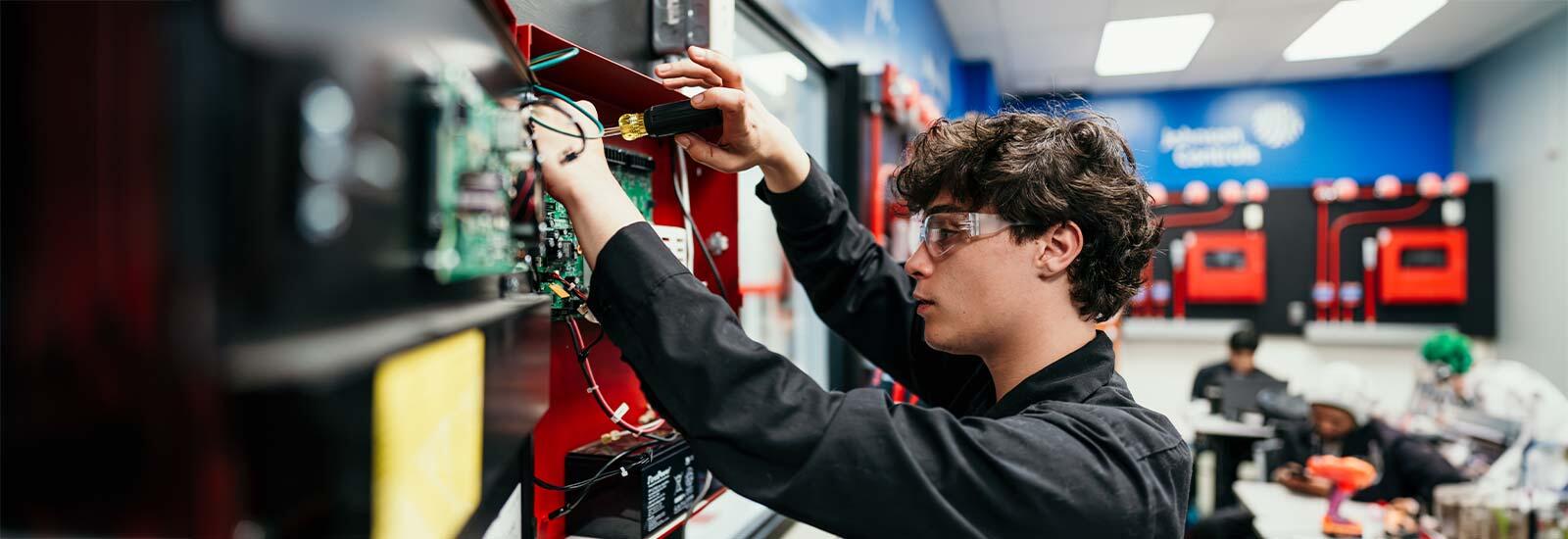
Real World Training for a Hands-On Career.
Electrical and Electronics Systems Technology Diploma Program in East Windsor
Electrical and Electronics Systems Technology — East Windsor
ESTX100 — Diploma Program
CIP Code: 46.0302
SOC Code: 47-2111 49-2098 49-2022 27-4011 47-3013 49-2097
Day, Afternoon, Evening Programs
| Total Semester Credit Hours | 50.0 |
|---|---|
| Instructional Hours | 1200 |
| Weeks to Complete — Day | Approximately 52 weeks (including holidays and scheduled breaks) |
| Weeks to Complete — Afternoon | Approximately 52 weeks (including holidays and scheduled breaks) |
| Weeks to Complete — Evening | Approximately 52 weeks (including holidays and scheduled breaks) |
Program Objective
This program is designed to provide the essential skills and knowledge for the installation, troubleshooting, repair, and maintenance of commercial and residential entertainment, security, monitoring, and telecommunications systems.
Students learn to install cable support structures; laying out and preparing pathways for wiring and cables; installing, securing, testing, and termination of wiring and cables both copper and fiber optic; program digital components and access controls to perform their designated tasks; install and set up media management systems; and perform system commissioning and user training of audio, video, and data systems. The program also prepares students on the essential skills and knowledge needed for entry-level residential electrician work. Students will train on the installation, service and maintenance areas of the residential electrical industry. They will also complete a 30-hour OSHA-approved safety orientation that explains job site hazards, accident prevention, and standard safety procedures.
Upon completion of this program, graduates can meet the minimum requirements needed to be qualified as an entry-level technician in the residential and/or commercial telecommunications, fire alarm, intrusion detection, and signaling, entertainment, audio/video/data, and energy management systems. Students can also qualify as entry-level residential electrician’s apprentice.
In addition to the technical training, a critical aspect of a Lincoln education is developing the professional skills that are required by our employers. Students will need to demonstrate skill proficiency through a series of professional development activities and seminars which are integrated into each course. The modules include: Student Success, Financial Literacy, Professional Development, and Career Success.
Students will be required to complete out-of-class assignments in each course.
Foundation Courses
| Lecture Hours | 60 |
|---|---|
| Lab / Shop Hours | 60 |
| Clinical Hours | 0 |
| Total Hours | 120 |
| Total Credits | 5.0 |
| Prerequisites |
None |
Course Description
The student will be taught how to use basic information for electrical and electronic industries as well as some basic concepts used in performing the electrical and low voltage technician’s skill-sets. Material covered includes basic safety, mathematical principles focused on whole numbers, fractions, measurement, decimals, percentages, and the metric system. Additionally, students will be taught how to use hand tools and power tools most commonly used the trades, i.e.: screwdrivers, tape measures, hand saws, drills, etc.
Core Courses
| Lecture Hours | 60 |
|---|---|
| Lab / Shop Hours | 60 |
| Clinical Hours | 0 |
| Total Hours | 120 |
| Total Credits | 5.0 |
| Prerequisites |
None |
Course Description
The student will learn how to use basic blueprint concepts, and the hardware and systems used by an electrical and electronics technician to mount and support boxes, receptacles, and other low voltage components. The student will learn how to use the various types of anchors and supports, their applications, and how to install them safely. Additionally, an overview of electrical raceways from source to destination provided. The student will learn how to use conduit types and bending techniques which completes the student’s training in this course.
| Lecture Hours | 60 |
|---|---|
| Lab / Shop Hours | 60 |
| Clinical Hours | 0 |
| Total Hours | 120 |
| Total Credits | 5.0 |
| Prerequisites |
None |
Course Description
This course provides the student with a general introduction to the concepts used in Ohm’s Law applied to DC series, parallel and combined circuits. This course also provides an introduction to concepts used in AC circuits. Topics include electrical theory, electromotive force, resistance, capacitance, inductance, impedance and power equations. Students will study Semiconductors and Integrated circuit theory with hands on lab time to reinforce the learning. Students will study schematic symbols and practice building circuits from schematic diagrams. Students also study appropriate application of proper diagnostic and maintenance procedures using electrical and electronic test equipment to include: meters, oscilloscopes, meg- ohm-meter, watt meters, frequency meters/generators, time domain reflectometers, continuity testers, recording instruments, and RF analyzers.
| Lecture Hours | 60 |
|---|---|
| Lab / Shop Hours | 60 |
| Clinical Hours | 0 |
| Total Hours | 120 |
| Total Credits | 5.0 |
| Prerequisites |
None |
Course Description
This course introduces the student to the electrical trade and provides them with knowledge in the areas of Electrical safety and residential electrical services. It also introduces them to the National Electrical Code and how to find the applicable codes and requirements in the electrical trade. It further provides the student with knowledge in the areas of grounding and bonding of electrical systems; NEC regulations pertaining to grounding and bonding; equipment and devices used for grounding and bonding. Students will also learn about other types of equipment and devices used in the electrical and electronic trades.
| Lecture Hours | 60 |
|---|---|
| Lab / Shop Hours | 60 |
| Clinical Hours | 0 |
| Total Hours | 120 |
| Total Credits | 5.0 |
| Prerequisites |
EEST103, EES104 |
Course Description
This course will provide the student with thorough understanding various types of conductors used in all types of electrical systems. Students will learn how to terminate conductors with different applications with the appropriate connector and/or terminal. Additionally, students will learn and practice installing conductors, pull and junction boxes using a variety of fasteners needed for a given application. Finally, they will learn the fundamentals of solar voltaic systems including design and configuration and installation.
| Lecture Hours | 60 |
|---|---|
| Lab / Shop Hours | 60 |
| Clinical Hours | 0 |
| Total Hours | 120 |
| Total Credits | 5.0 |
| Prerequisites |
EES101 or EES101A; EES103; EES104; EES105 |
Course Description
This course will provide the student with a thorough understanding and functions of the various components used in motor control systems. The student will be introduced to the maintenance and troubleshooting functions of motor controls systems. The student will also learn about the different types of devices and components used within motors controls systems. The course will also focus on basic guidelines and procedural information for receiving and storing, handling and installing lamps and lighting fixtures. The student will learn about (NEMA) National Electrical Manufacturers Association as they prepare to work with magnetic coils and relays, contacts and holding circuit interlock and other structural features of solenoids, timers, starters and contactors. The student will also learn about fuses and circuit breakers. They will understand how they provide protection to electrical conductors and equipment against abnormal conditions. Students will also become familiar with Programmable Logic Controllers and programming them by usage of logic ladders.
| Lecture Hours | 60 |
|---|---|
| Lab / Shop Hours | 60 |
| Clinical Hours | 0 |
| Total Hours | 120 |
| Total Credits | 5.0 |
| Prerequisites |
EES101A or EES101, EES103, EES104 |
Course Description
This course provides the student knowledge of the basic operation of telephone systems, types of system cables, cable color coding, cable connectors, and installation techniques in addition to identifying the types of data networks, test equipment, and procedures used in testing cables. The student will use the proper procedure and technique to install fiber-optic cabling and support equipment, while describing or demonstrating the types of fiber-optic splicing and/or terminations to achieve an acceptable and “test verified” loss within a specified and acceptable range. In addition, the student will be able to network several computers together back to a main computer.
| Lecture Hours | 60 |
|---|---|
| Lab / Shop Hours | 60 |
| Clinical Hours | 0 |
| Total Hours | 120 |
| Total Credits | 5.0 |
| Prerequisites |
EES101A or EES101, EES103, EES104, EES105 |
Course Description
This course is designed to provide the student with the knowledge and skills to install and troubleshoot call signaling systems, entry/access control systems, intrusion detection, security, and surveillance systems (included is CCTV system and key components of a CCTV system) Students will learn the function and how to install and troubleshoot systems in the areas of access control, security systems and intrusion detection, video surveillance. The students will also gain fundamental knowledge of low voltage cabling used in these systems as well as other low voltage systems.
| Lecture Hours | 60 |
|---|---|
| Lab / Shop Hours | 60 |
| Clinical Hours | 0 |
| Total Hours | 120 |
| Total Credits | 5.0 |
| Prerequisites |
EES101A or EES101, EES103, EES104, EES105 |
Course Description
This course provides the student with the knowledge and skills required to successfully, plan, install and problem-solve, both standard Fire Alarm systems and Programmable Fire Alarm systems. Students will be taught the proper methods and equipment to use in residential and industrial fire- detection applications. Proper wiring/cable selection, fire-detection equipment selection, and system layout/planning will be obtained in this course of study. Programming of Fire Alarm devices and systems will be introduced. Theory of typical Fire Alarm software will be presented in this course of study. Hands-on practices of the software applications are included in the course of study.
| Lecture Hours | 60 |
|---|---|
| Lab / Shop Hours | 60 |
| Clinical Hours | 0 |
| Total Hours | 120 |
| Total Credits | 5.0 |
| Prerequisites |
EES101A or EES101, EES103, EES104, EES105 |
Course Description
This course is designed to provide the student with the knowledge and skills required to install and troubleshoot rack systems, system integration, and residential systems integration. The students will be taught component function and how to install complete systems racks, residential automation systems. The students will be taught system commissioning and how to train client based systems. In addition, they will learn finish phase testing along with maintenance and repair and will also complete a 30-hour OSHA approved safety orientation that explains job site hazards, accident prevention, and standard safety procedures.
Notes:
NOTE: Course numbers and sequences are listed here for reference only. The actual delivery sequence of courses contained in this program may vary depending on individual campus scheduling. Maximum Time Frame: 75 semester credits.
1 O*NET OnLine, https://www.onetonline.org/link/localtrends/47-2111.00?st=CT. Retrieved July 10, 2025.
2 These companies have hired one or more 2021 – 2024 Lincoln graduates to work in their field of study.
Mode of Delivery: Residential, Blended Learning or Online are the methods we may use to deliver content in each course. The Residential courses are offered on ground at the campus. Blended courses are offered by delivering a fraction of the course in an online format as well as traditional face to face method. Online courses are delivered 100% online. The Blended delivery and online delivery plan will implement distance education activities into each course in the program of study. The use of simulations, case studies, assessments and multimedia will be used to enhance the students understanding of the learning objectives outlined in the course syllabus.
The listing of credits is not meant to imply that credits can be transferred into college or other private career school programs. Transfer credits are at the sole discretion of the receiving school.
Take the next step
Complete this simple 3-step form to get started. Click "Next" to go to Step 2.