How To Read A Resistor: A Beginners Guide


In this article, we present a handy guide on how to read and calculate the value of a resistor as used in a direct current circuit. Before we get into the details of the calculation, let’s review Ohm’s law, and how resistance is calculated.
Ohm’s Law Revisited
The principle known as Ohm’s Law is named in honor of the German physicist, Georg Ohm. In his 1827 publication titled “The Galvanic Circuit Investigated Mathematically”, Ohm defined the relationship between resistance, voltage, and current, stating that if any of the two values are known, the third can be calculated through one of three formulas.
To find Voltage, multiply the known current by the known resistance (V=C/R). To find Current (also known as amperes, C=V/R), simply divide the known voltage by the known value of resistance. The third formula is for Resistance (R=V/C), which states that resistance can be calculated by dividing the known voltage by the known current value. Resistance is represented by the Omega character: Ω
What Does a Resistor Do?
As we described in our article about basic electrical symbols, a resistor is an electrical component that is used to set voltage levels and protect components against excessive current. A resistor restricts the flow of electrical current; the lower the resistance, the easier it is for current to pass through it. As resistance is increased, the flow becomes more restricted, lowering the flow of current.
Resistors come in many sizes and thousands of resistance values, and the engineer designing a circuit will want to know exactly what value resistor(s) might be required to precisely control the current in the circuit they are designing. It logically follows that the technician who is seeking to understand a circuit design for troubleshooting or repair purposes will also want to know the exact resistance value of the resistors used in a circuit they are examining.
How to Read a Resistor: Color Codes, Bands, and Practical Tips
Because resistors can come in an almost unlimited number of resistance values, an accurate visual coding system was devised to properly mark a resistor. The system is composed of color-coded stripes, and the number and position of each color stripe indicates a specific value. Reading them in the proper order is absolutely crucial in making the correct calculation.
The Resistor Color Code Chart
The color code chart is divided into 6 columns. Each column has a fixed range of possible values, and those values are coded by color. The combination and order of the color bands indicate the values to be combined to reveal the resistance value of the resistor.
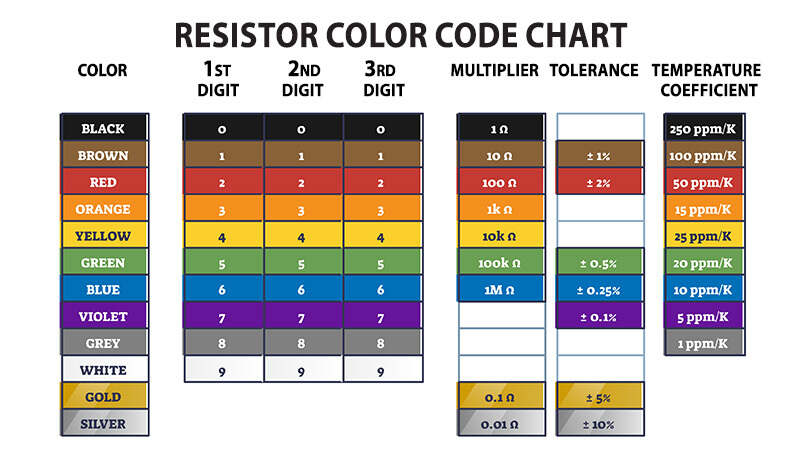
Tips For Accurately Reading a Resistor
Understanding the definitions and meaning of each of the 6 values in the color-code chart is crucial for an engineer or electrical technician to know. It is important to learn these rules to produce an accurate resistor value calculation.
Learning the functions of multipliers, tolerance, and temperature coefficients, as well as color band order, is key to calculating resistance, so we will cover that first before demonstrating reading direction and calculation.
Resistor Multipliers, Tolerance, and Temperature Coefficient
- Multiplier: This multiplier is applied to the sum of the first 2 or 3 bands, effectively producing a final value anywhere between milliohms and megaohms.
- Resistor Tolerance: The measurement denotes how accurately a resistor is manufactured, and if the potential variation will negatively affect the circuit. Tolerances run as tight as a +/-0.1% and as wide as 10%. No tolerance indicator means a +/-20% tolerance.
- Temperature Coefficient: The coefficient tells us how accurate the resistance value remains during temperature fluctuations. This is both useful and necessary for devices that must reliably function in critical environments. Examples include medical and military applications.
3-Band & 4-Band Resistors
- Bands #1 and #2 represent the resistance value in ohms.
- Band #3 is the multiplier value.
- Band #4 (if present) represents the resistors tolerance.
5-Band & 6-Band Resistors
- Bands #1, #2, and #3 represent the resistance value in ohms.
- Band #4 is the multiplier value.
- Band #5 represents the resistors tolerance.
- Band #6 represents the temperature coefficient.
Determining Reading Direction of a Resistor’s Color Bands
The typical resistor has an identical looking wire lead emerging from both ends of the component. This can cause confusion as to which way to orient the resistor for establishing the proper reading direction. Here are a five clues that can help in identifying the correct left-to-right reading direction of a resistor.
- On a 3-band resistor, the first 2 bands represent the ohm value, and the third is the multiplier. These 3 bands would be grouped on one side. This is the left side of the resistor, and it should be read from left-to-right.
- A 4-band resistor is very similar to a 3-band, except for the addition of a tolerance value as the 4th band. Look for a larger spacing between the 3rd and 4th bands, somewhat isolating the 4th band. This band is a tolerance band, and it is on the right side of the resistor. Read the resistor from left-to-right.
- On 5-band resistor, the first 3 bands are the ohm values, and the 4th band (the multiplier) is grouped with the ohm value bands on the left side of the resistor. There should then be a larger spacing between the 4th and 5th bands, with the 5th being the tolerance band.
- The 6-band resistor is read the exact way as the 5-band resistor, except the addition of the 6th band on the right most side indicates the temperature coefficient.
- Look for Gold or Silver Bands – these only appear as either multipliers and/or tolerance indicators. These will always be to the right of the ohm value bands.
Reading The Color Bands Left to Right
Using the color band chart, definitions and reading order rules in the previous section, we can now apply them to the following examples:
4-Band Resistor Example
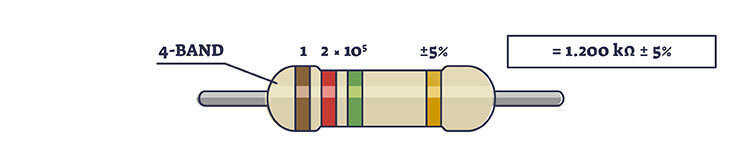
Using the chart and positions as a guide, we produce the following values for this 4-band resistor, reading from left-to-right:
- 1st Band: Brown = 1
- 2nd Band: Red = 2
- 3rd Band (Multiplier): Green = 100K
- 4th Band (Tolerance): Gold = +/-5%
Calculation: 1 2 * 100K = 1,200,000 Ohms, or 1.2M Ohms (Expressed above as 1,200K Ohms). The +/-5% tolerance means that the resistor can be expected to measure from 1.14M Ohms to 1.26M Ohms, and still be within expected tolerance.
The 5-Band Resistor
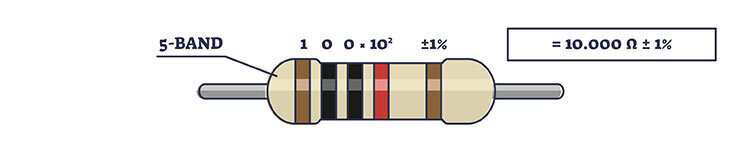
On a 5-band resistor, the first 3 digits represent the resistance value in Ohms, followed by the 4th band, which is the multiplier. The 5th band in this case is the tolerance expected. Here is how this 5-band resistor reads:
- 1st Band: Brown = 1
- 2nd Band: Black = 0
- 3rd Band: Black = 0
- 4th Band (Multiplier): Red = 100
- 5th Band (Tolerance): Brown = +/-1%
Calculation: 1 0 0 * 100 = 10,000 Ohms. The +/-1% tolerance means that the resistor can be expected to measure from 9,900Ω – 10,100Ω.
The 6-Band Resistor
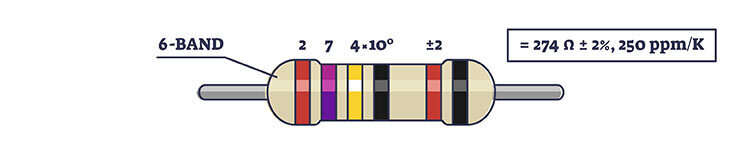
6-Band Resistors are usually used in many specialized applications, such as medical devices and military applications. Here is this 6-band resistor reads:
- 1st Band: Red = 2
- 2nd Band: Violet = 7
- 3rd Band: Yellow = 4
- 4th Band (Multiplier): Black = 100
- 5th Band (Tolerance): Red = +/-2%
- 6th Band )Temp Coefficient): Black = 250 ppm/K
Calculation: 2 7 4 * 100 = 274 Ohms. The +/-2% tolerance means that the resistor can be expected to measure from 268.52Ω – 279.48Ω. The 6th band represents the temperature coefficient of 250ppm/K.
Verifying If Your Calculation Is Accurate
There are two easy ways to test your color band calculations:
Use an online resistor calculator
There are many from reputable sources, such as a major manufacturer or governing body. Panasonic has an excellent color resistor code calculator that covers 4-to-6 band resistors, and Codrey Electronics has one that covers 3-to-6 band calculator.
Use A Multimeter To Verify The Resistor
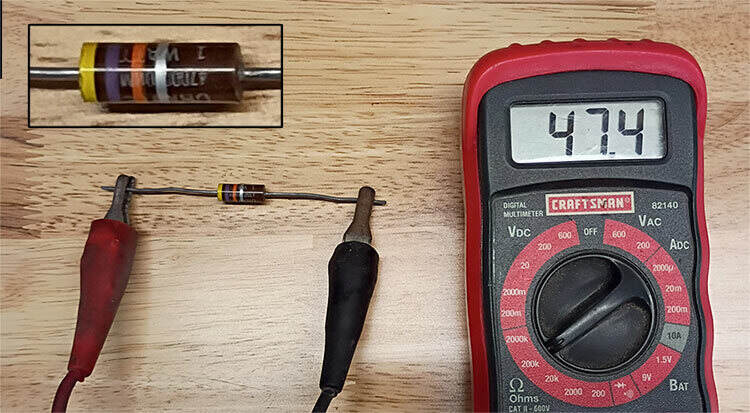
Multimeters are a great tool for confirming a color-code reading. This example uses a resistor that is showing 4 stripes. Read from left-to-right, the colors are yellow, violet, orange, and silver. Here’s how this resistor is read:
- 1st Band: Yellow = 4
- 2nd Band: Violet = 7
- 3rd Band (Multiplier): Orange = 1,000
- 4th Band (Tolerance): Silver = +/-10%
Calculation: 4 7 * 1000 = 47,000 Ohms.
Frequently Asked Questions About Resistors
What's an easy way to remember resistor colors?
A well-known pneumonic for remembering resistor color codes is: “Bright Boys Rave Over Young Girls But Veto Getting Wed”, which can help you remember “Black, Brown, Red, Orange, Yellow, Green, Blue, Violet, Gray, White”.
What does a missing tolerance color band mean?
A resistor that does not have a tolerance band has, by default, a +/-20% tolerance.
Are there resistor value identifier apps for Android or iPhone?
Yes, Google Play currently has at least 8 resistor color code apps for Android, while the Apple store offers at least a dozen resistor color code apps for iPhone. If you plan on downloading an App, be careful to read the reviews for each, and only download from a reputable source.
Final Notes
Keep in mind that resistors come in many shapes, sizes, and types. There are 6 types of commonly used resistors, three of which have fixed resistance (Carbon Composition, Metal Film, and Wire-Wound), a variable resistor called a Potentiometer, and two non-linear resistors (Thermistors, and Light-Dependent Resistors (LDRs)). The resistor used in the live example above is a Carbon Composition resistor. Keep in mind that practicing the reading of color bands and checking your calculation with a multimeter is a great way to gain a better understanding of how resistors behave and the tolerances they are manufactured to meet. When working with any electrical component, always follow proper safety procedures and wear personal protective equipment (PPE).
Take the next step
Complete this simple 3-step form to get started. Click "Next" to go to Step 2.